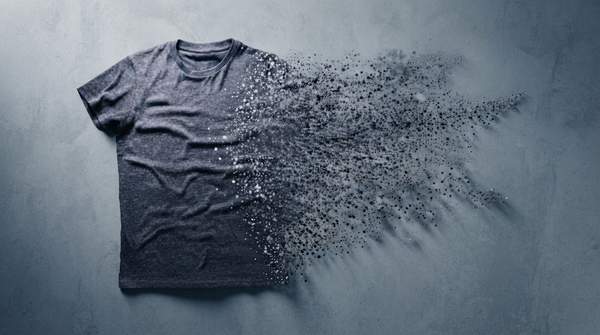
Every wash of a polyester or nylon garment releases thousands of plastic fibers, and a substantial share of them slip through wastewater treatment into rivers, soil and the ocean, where they are ingested by wildlife and can re-enter the human food chain. The UN Environment Programme is blunt about the consequence: "when they end up in the environment, they also end up in our food chain." Understanding the pathway from closet to ecosystem, and which choices along that pathway actually reduce shedding, is the most practical lever a consumer has over this form of pollution.
The Hidden Threat in Your Wardrobe: What Are Microplastics From Textiles?
Microplastics are, as the name suggests, tiny fragments of plastic, and the textile variety typically takes the form of fibers shed from fabric. The European Environment Agency notes in its analysis of microplastics from textiles that these particles are usually fibre-shaped, which is why researchers often call them microfibres. Crucially, the agency distinguishes synthetic fibers, which cause microplastic release, from fibers of natural origin, which shed microfibres of their own but do not constitute plastic pollution.
The scale of the problem follows from the composition of the modern wardrobe. According to the marine conservation organization Seas at Risk, roughly 70 percent of textiles produced today are synthetic, and these materials account for about 35 percent of the total microplastics released into the ocean, making fashion one of the largest global sources of microplastic pollution. The same organization emphasizes that the dispersion of nylons, polyesters and acrylics is not only a matter of wash and wear; it begins at design and production, and continues through garment use and end-of-life disposal.
A storymap on fashion and microplastics by Chloe Sanders, published through Esri, adds a striking geographic data point: a study conducted at the North Pole found that 73 percent of microfiber pollution there consists of polyester fibers resembling the PET used in textiles. If synthetic fibers are detectable in Arctic waters, the implication is that no environmental compartment is insulated from laundry-derived pollution.
The Microplastic Journey: From Your Closet to the Ecosystem
The clearest way to grasp the problem is to follow a single fiber through each documented stage of its journey. The sequence below traces that pathway, from the moment a garment enters a washing machine to the point at which the fiber may return to human bodies.
- Shedding in the wash. A synthetic garment releases fibers whenever it is agitated in water. The Pacific Salmon Foundation's marine science program estimates that a single load of laundry can release roughly 700,000 bits of microplastic, and that laundering accounts for over 35 percent of microplastic pollution overall.
- Release into wastewater. The fibers leave the machine suspended in the wash water, which drains into household wastewater and, in most homes, municipal sewage systems.
- Partial capture, partial escape. Because the particles are so small, they often escape wastewater treatment facilities, as the Pacific Salmon Foundation's guidance explains. Treatment plants were not designed around particles of this size, so a portion of the load passes through into natural waterways.
- Dispersal across environments. Once in waterways, fibers reach the ocean, rivers and, as the Seas at Risk analysis notes, accumulate across these compartments. The European Environment Agency adds that microplastics from textiles are found across the wider environment rather than in any single sink.
- Uptake by organisms. In water and soil, microplastics are ingested by animals, entering food webs. The Esri storymap, citing an infographic from the German nonprofit Stop! Micro Waste, illustrates the cycle of fibers shed through wash cycles entering food sources and eventually being ingested by humans.
- Return to people. The UN Environment Programme confirms that microplastics in the environment end up in our food chain, and that they can enter the human body through both ingestion and inhalation.
Two features of this sequence deserve emphasis. First, the pathway is not linear in practice: fibers released at any stage can settle in soil, freshwater or marine sediment, and be re-mobilized. Second, the critical bottleneck is the treatment plant, which is where consumer-side interventions, discussed below, have their greatest leverage.
Ecological and Potential Health Impacts of Microplastic Pollution
The documented ecological harms begin in soil. According to the Esri storymap, microplastics can inhibit crop growth by grasping the surfaces of roots and seeds, stopping seed germination, root elongation and the absorption of water and nutrients. In aquatic systems, ingestion by animals introduces fibers into food webs, where their persistence makes them essentially impossible to clean up once dispersed, as the Pacific Salmon Foundation's guidance stresses for the marine environment.
The picture for human health is more tentative, and it is important not to overstate it. The storymap reports that ingesting microplastics is known to damage the liver, the immune system, energy production and the reproductive system, while inhaled plastics can damage the lungs. The UN Environment Programme frames the exposure question concretely: one 2019 study found that some adults could potentially consume between 39,000 and 52,000 microplastic particles per year on average, depending on location and behavior, and it notes that whether nanoplastics, particles less than one micrometer across, may even slip through the skin remains unconfirmed.
The European Environment Agency, for its part, is explicit about the limits of current knowledge. It states that the fates and effects of textile microplastics are currently largely unknown, making it hard to determine the severity of the issue and the measures required, and it calls for more research on release mechanisms, transport, ecosystem and health impacts, and scalable solutions. A certain degree of chronic exposure, the agency adds, is unfortunately an integral part of contemporary life. The honest summary is that ecological harm is well documented, while the severity of human health effects remains an open scientific question.
Making Informed Choices: Reducing Your Microplastic Footprint
Consumers can significantly reduce their contribution to microplastic pollution by adopting mindful laundry practices and considering fabric choices, and the evidence points to several specific levers. The most consequential variables are machine type, cycle length, water temperature and wash frequency.
On machinery, the European Environment Agency reports that top-loading washing machines induce significantly more shedding than front-loading models, probably because of greater abrasion during tumbling. On settings, the Pacific Salmon Foundation's marine science program advises cold water, since warm water breaks fabrics down faster; shorter cycles, avoiding gentle and other settings that extend wash time; and air-drying, because the heat and friction of a tumble dryer also degrade fabric.
On behavior, the same guidance recommends washing sparingly, considering whether a garment can be worn again and spot-cleaning spills rather than washing the entire item. Two capture technologies complete the toolkit: external microfiber filters fitted to the washing machine, and mesh laundry bags, such as the Guppyfriend, in which synthetics are washed so fibers are caught before they reach the drain. Material choice is the final lever: natural fibers shed microfibres too, but as the European Environment Agency notes, only synthetic fibers cause microplastic release.
The measurable indicator of progress is straightforward: a decrease in laundry frequency, a switch to cold-water washes, and the adoption of a microfiber filter or laundry bag. Each of these is observable in your own routine, and each acts directly on the pathway traced above, either by reducing the fibers shed or by intercepting them before they reach wastewater. The next milestone worth watching is the state of research the European Environment Agency calls for, on scalable solutions and the health effects that remain, for now, largely unknown.
Sources
- Everything you should know about microplastics — UNEP - UN Environment Programme
- Microplastics from textiles: towards a circular economy for textiles in Europe — EEA
- SEAS AT RISK
- Reduce Microplastics Pollution from Your Laundry — PSF Marine Science Program
- Fashion and Microplastics — ArcGIS StoryMaps