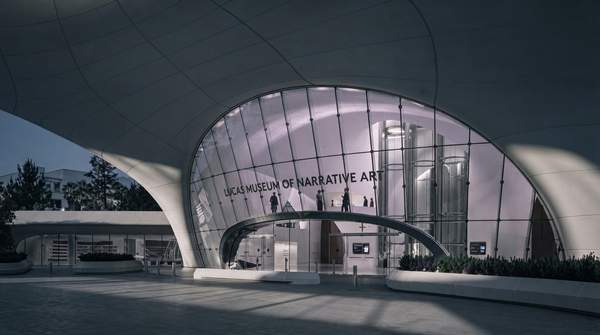
The Lucas Museum of Narrative Art, which opened to the public on September 22, 2026, in Los Angeles's Exposition Park, is built on a single idea expressed twice: that visual storytelling is a universal human activity, and that the museum celebrating it should itself feel like a story being told. The museum's own materials describe its purpose as exploring how narrative art "shapes our world—expressing beliefs, communicating values, expanding imagination, and inviting conversation," while architect Ma Yansong of MAD conceived the building as a "sculptural, organic form shaped by light, clouds, and the surrounding tree canopy." The design and the collection are not parallel projects; they are, in the institution's framing, two sides of one vision.
The Lucas Museum: A Unified Vision of Art and Storytelling
Founded by George Lucas and Mellody Hobson, the museum defines its subject broadly. Its press materials describe an institution that traces visual storytelling "across cultures and centuries—from prehistoric cave paintings to illustration, comics, cinema, and murals." That sweep is deliberate: the museum's homepage organizes its galleries around themes such as "Drawing Us to Adventure" (comics), "Inspiring Wonder" (children's stories), and "Escaping into Other Worlds" (fantasy), closing with the phrase "from timeless myths to cinematic galaxies far, far away—stories connect us."
The founding vision carries a personal inflection. The museum's campus page quotes Lucas, its co-founder, on the building itself: "This art is important. Let's put it in an important building." That sentence, in miniature, is the institution's argument—that the container should be commensurate with the art, and that architecture can participate in the storytelling rather than merely house it.
What the museum means by narrative art has been articulated most directly by its chief executive. In an interview reported by Matt Stevens and Robin Pogrebin of The New York Times ahead of the opening, Tracey Bates described the institution as "a museum focused on storytelling in all its forms," adding: "Narrative art is the universal art of storytelling through images. It's existed throughout our lifetime. Storytelling has always existed. We're just now a museum that is platforming and showing that."
Architecture as Narrative: Ma Yansong's Organic Design
Ma Yansong's firm, MAD, has published its own account of the design's intent, and it is notably unguarded about the storytelling metaphor. The project page describes the building as serving "as a metaphor for storytelling and imagination, offering a space to explore new possibilities," conceived as "a reflection of Los Angeles's vibrant pioneering spirit and embrace of its diverse inhabitants, representing a celebration of dialogue, understanding, and inclusivity." The firm characterizes the result as a "biomorphic, dream-like form" with "fluid and soft shapes," an "organic sculptural form in a park that pushes the boundaries of architecture and creates a sense of wonder."
The museum's opening announcement extends that language into the visitor experience. The building, it states, is "designed with emotional architecture spaces, so that it is fluid in every part, and merged like a natural feature of the landscape into Exposition Park," inviting "everyone to participate in a journey of discovery and become part of the story of the Lucas Museum of Narrative Art." The phrase "emotional architecture" is the connective tissue: where a conventional museum building organizes visitors efficiently, this one is framed as organizing them narratively—into curiosity, movement, and arrival.
The museum's campus page attributes the design's shaping forces to natural elements—light, clouds, and the tree canopy—rather than to formal geometry. Executed with Stantec serving as executive architect, per the museum's press materials, the 300,000-square-foot building rises five stories above a landscaped campus, with the surrounding gardens designed by Mia Lehrer and her team at Studio-MLA.