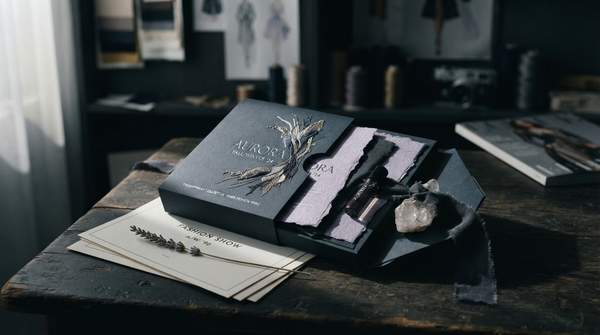
The fashion show invitation has quietly become one of the industry's most expressive design objects. What began as a simple card announcing a date and time has, over roughly a century, evolved into a bag of pasta, a folded newspaper, a petri dish — objects chosen precisely because they preview the story a collection is about to tell. How did a piece of administrative stationery become a collectible work of art?
The answer is a shift in purpose. Fashion writers tracking these objects describe modern invitations as "visual and tactile clues that anticipate the tone of the show" — collectible items and small design masterpieces that carry part of the narrative a brand builds around a collection. In a world where brand experience is everything, as design magazine Collater.al puts it, "even a simple invite becomes a message and a manifesto of intent." Major houses — Fendi, Gucci, Balenciaga, Jacquemus and Loewe among them — have elevated the invite into a creative statement rather than a mere logistical document.
The scale of this phenomenon is documented in the book "Invitation Strictly Personal" by fashion writer Ian R. Webb, whose curated collection spans hundreds of invitations across four decades from the four major fashion capitals. That archive, and the exhibitions built around it, gives us a lens for tracing how the invitation grew from functional card to conceptual object to full experiential package.
Phase 1: The Functional Card (Pre-1980s)
Invitations were not always art. In the 1920s, when the press began to play an important role in promoting fashion collections, guest lists were still limited and an invitation was essentially a ticket: it told you where to be and when. Hospitality did the charming — guests were offered champagne along with small gifts such as perfumes, and the invitation itself remained a modest informational object.
What changed over the following decades was the promotional package around the show rather than the card at its center. As the decades went by, the designer's accompanying materials grew increasingly elaborate, and today those packages can include makeup, show soundtracks and graphic works referencing the theme of the show. The seed of the invitation's transformation was planted here: once the show became a promotional event rather than a private viewing, everything the guest touched became part of the brand's communication.
By the late twentieth century, the invitation had absorbed that logic. It stopped being the paperwork for an event and started being the event's first act.